
|
Cooling with water is beneficial for a miniaturized cold plate
because, to cool the same power density, 4000 times less volume
is needed than with air. Miniaturization improves the maximal coolable
power density, albeit at the expense of an increased pressure drop.
For this reason, approaches that increase the power density while
reducing the pressure drop are important.
In jet impingement, the coolant is in direct contact with the backside
of the electronic component. This method incurs neither the thermal
resistance overhead of a base plate nor the overhead and reliability
problem of thermal interface materials. We focus on the design and
architecture of a micron-sized round nozzle array with interspersed
drainage holes on a face-centered quadratic lattice. The latter
has a novel parallel manifold that reduces the pressure drop for
large numbers of nozzles. This structure is similar to branched
hierarchical networks in animals and plants. These features are
fabricated using microfabrication of silicon wafers followed by
bonding processes.
A single-phase distributed-return submerged jet-impingement cold
plate with a nozzle array having a nozzle pitch of 100 µm
was designed and optimized. Using a hierarchical branching concept,
the pressure drop of the manifold feeding 50,000 inlet/outlet nozzles
was reduced to < 0.1 bar at a flow rate of 2.5 l/min
for a chip area of 4 cm².
Four main flow patterns that affect the heat transfer coefficient
could be identified: the pinch-off regime, the impingement regime,
the transition regime, and the separation regime. In the pinch-off
regime at gaps < 25 µm, the heat-transfer coefficient
and the pressure drop are inversely proportional to the gap. The
most practical range for a cold plate design is the impingement
regime with H ≥ 1.2 ,
where the heat-transfer coefficient is constant even for a changing
gap. The impingement regime increases with jet velocity and the
pitch-to-nozzle diameter ratio.
We show that the optimal jet plate structure has a nozzle diameter
of 25 µm at a cell pitch of 100 µm and a gap
of 30 µm.This results in a thermal resistance of 0.15 Kcm²/W.
The measured results of the device nearest to the optimum with
= 43 µm, a gap of 50 µm and a pitch of 150 µm
has a thermal resistance from junction to inlet of 0.17 Kcm²/W,
which is sufficient to cool power densities up to 370 W/cm²
for a 63 °C temperature increase at the junction. One of
the advantages of a small pitch of distributed return jet cold plates
is the high cooling-performance uniformity 0.5 °C.
Another advantage is the elimination of both the thermal interface
material and the base plate of a cold plate with its thermal resistance
and reliability issues.
In summary we have demonstrated direct jet impingement chip cooling
technology capable of cooling power densities of 400 W/cm²
six times more than the current limit of air cooling and
two times the current processor design limitation of 200 W/cm².
Direct single-phase liquid impingement on the chip backside eliminates
thermal interfaces, which are a major reliability concern and performance
bottleneck for all current cooling solutions. Two parallel manifolds
with a dual branching concept distribute and drain coolants to and
from 50,000 nozzles microfabricated by deep reactive ion etching
of silicon. The minor dependence on coolant viscosity in thin impingement
gaps and ultrashort ducts allows excellent performance for the cooling
of low-temperature CMOS. We are currently focusing on further increases
of cooler performance with surface-enhancement structures. We are
also testing approaches to form sealed modules after low-temperature
bonding to processors or other surfaces.
Coolers with branched hierarchical feed and drain networks are
being explored in collaboration with ETH
Zurich.
Although the emphasis is on single-phase cooling for short-term
applications, two-phase liquid cooling
is also being explored as part of a longer-term effort.
References
| [1] |
T. Brunschwiler, B. Smith, E. Ruetsche, and B. Michel, "Datacenters with Direct Energy Re-use," Proc. Intl. Supercomputing Conference, June 17-19, Dresden, Germany (2008).
|
| [2] |
B. Agostini, R. Revellin, J.R. Thome, M. Fabbri, B. Michel, D. Caimi, and U. Kloter, "High Heat Flux Boiling in Silicon Multi-Microchannels: Part III - Saturated Critical Heat Flux of R236fa and Two Phase Pressure Drops," J. Heat and Mass Transfer, in press (2008).
|
| [3] |
B. Agostini, J.R. Thome, M. Fabbri, B. Michel, D. Caimi, and U. Kloter, "High Heat Flux Boiling in Silicon Multi-Microchannels: Part I - Heat Transfer Characterstics of Refrigerant R236fa," J. Heat and Mass Transfer, in press (2008).
|
| [4] |
B. Agostini, J.R. Thome, M. Fabbri, B. Michel, D. Caimi, and U. Kloter, "High Heat Flux Boiling in Silicon Multi-Microchannels: Part II - Heat Transfer Characterstics of Refrigerant R2245fa," J. Heat and Mass Transfer, in press (2008).
|
| [5] |
B. Agostini, M. Fabbri, J.E. Park, L. Wojtan, and J.R. Thome, "State of the Art of High Heat Flux Cooling Technologies," Heat Transfer Engineering 28(4), 258-281 (2007).
|
| [6] |
B. Agostini, J.R. Thome, M. Fabbri, and B. Michel, "High Heat Flux Two-Phase Cooling in Silicon Multi-Microchannels," IEEE Trans. on Components and Packaging Technologies, in press (2007).
|
| [7] |
M. Fabbri, A. Wetter, B. Mayer, T. Brunschwiler, B. Michel, H. Rothuizen, R. Linderman, and U. Kloter, "Micorchip Cooling Module Based on FC72 Slot Jet Arrays without Cross-Flow," 22nd IEEE SEMI-THERM Symposium, San Jose, CA, (2006).
|
| [8] |
T. Brunschwiler, H. Rothuizen, M. Fabbri, U. Kloter, B. Michel, R.J. Bezama,
and G. Natarajan, "Direct Liquid Jet-Impingement Cooling with Micron-Sized
Nozzle Array and Distributed Return Architecture," 20th ITHERM Conference,
San Diego (2006).
|
 |
|
 |
 |
Distributed return architecture
with cross section showing inlet jets with neighboring drainage
holes. |
 |
 |
|
 |
 |
 |
Scheme of hierarchical manifold
with branching factor of 3 (a). Cross section through layered
chip (b). 3D representation of one inlet and one outlet tree
(c). Top view of one double-branched cell with interdigitated
inlet/outlet (d). |
 |
 |

|
 |
 |
 |
SEM section of two-level
jet plate with interface, jet-impingement gap and chip added.
Water flow is indicated by blue arrows. |
 |
 |
|
 |
 |
 |
CFD model of fluid flow
with gap variation at constant flow rates showing "pinchoff"
(a), "transistion" (b), and "impingement"
regimes (c). |
 |
 |
|
 |
 |
 |
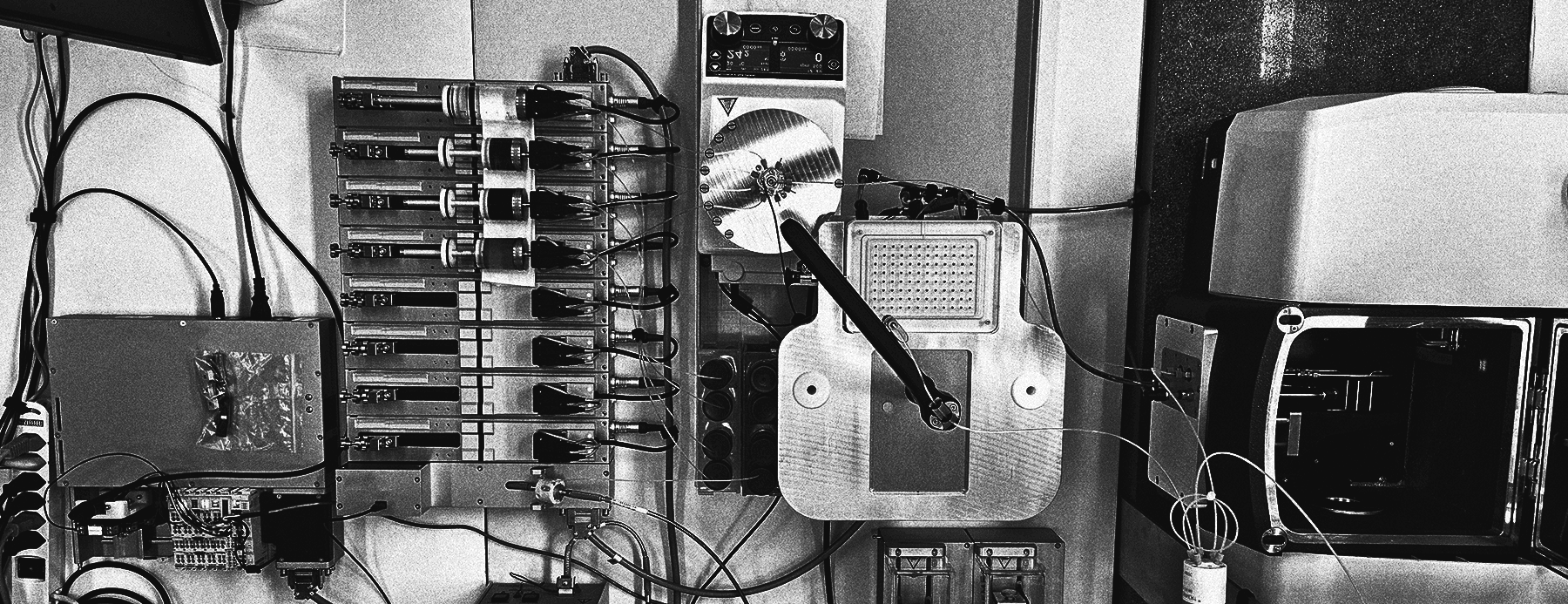
Scheme and photo of impingement
cooling test station. |
 |
 |
|
 |
 |
 |
Comparison of Nusselt numbers
as function of the Reynolds numbers for all the designs fabricated
in this study. |
 |
 |
|
 |
 |
|