
IBM®
Skip to main content
    Zurich Research Laboratory      Terms of use


     Home      Products      Services & solutions      Support & downloads      My account     
IBM Research

SATI: Self-assembly, transfer and integration


Project overview

Synthetic methods are available today for synthesizing large quantities of very small particles. Ranging from semiconductor quantum dots to metal nanowires, such particles possess unusual properties that have made them one of the fastest-growing fields of materials research. However, bottom-up bulk-synthesis uses different and more complex chemistry than is common in semiconductor technology. Particles are usually created in colloidal suspensions with rather involved surface chemistries, whereas applications often demand well-ordered, surface-bound structures and simple surfaces. There is a wide gap between this new approach and conventional fabrication. We aim to bridge this gap with novel processes that take advantage of the bottom-up approach but fit into existing technology. One of them is called SATI, for "self-assembly, transfer and integration". Figure 1 shows the different steps of the SATI process.

The SATI process starts with directed self-assembly, in which disordered particles (from a powder or a suspension) are arranged in a template. The level of adhesion is low enough that these particles can be picked up for the adhesion-based transfer, where they adhere to an intermediate carrier, for example a flat elastomer slab. In the last step, the carrier is aligned and brought into contact with the target substrate for the aligned integration of the particles. In this project, we are collaborating with Nicholas D. Spencer's group at ETH.

Parts of the SATI process were developed in projects supported by the State Secretariat for Education and Research (SER) in the framework of the EC-funded project NaPa (Contract No. NMP4-CT-2003-500120) and by the Swiss Commission for Innovation (KTI).

Images, click to enlarge
Figure 1. Steps of the SATI process.
Steps of the SATI process
Figure 2.
Polystyrene beads
Figure 3.
Polystryrene beads
Figure 4.
Polystryrene beads
Figure 5.
Polystryrene beads
Figure 6.
Polystryrene beads
Figure 7.
Printed particles
Figure 8.
Printed particles
Figure 9.
Assembly of particles
Figure 10.
Particles on stamp
Figure 11.
Lithography
Figure 12.
Coated beads
 CAPA: Capillarity-assisted particle assembly  

Several research groups have shown that objects of various shapes, sizes and materials can be arranged in regular structures through self-assembly. The resulting geometries are usually a function of particle geometry and properties. In order to create arbitrary structures, templated assembly methods are suitable. They force the particles to arrange in predefined positions of the template. The driving force depends on the particle size and can be gravitation, capillary forces, hydrodynamic drag, electric or magnetic fields, or molecular recognition of species on the particles. Of these, capillary forces are particularly interesting to us, as they are compatible with various materials and do not require specific chemical modifications.

Using so-called capillarity-assisted particle assembly, or CAPA, we have created a variety of structures, for example from 500-nm diameter polystyrene beads. The structures were then transferred onto substrates using the SATI process, resulting in the structures shown at the right.

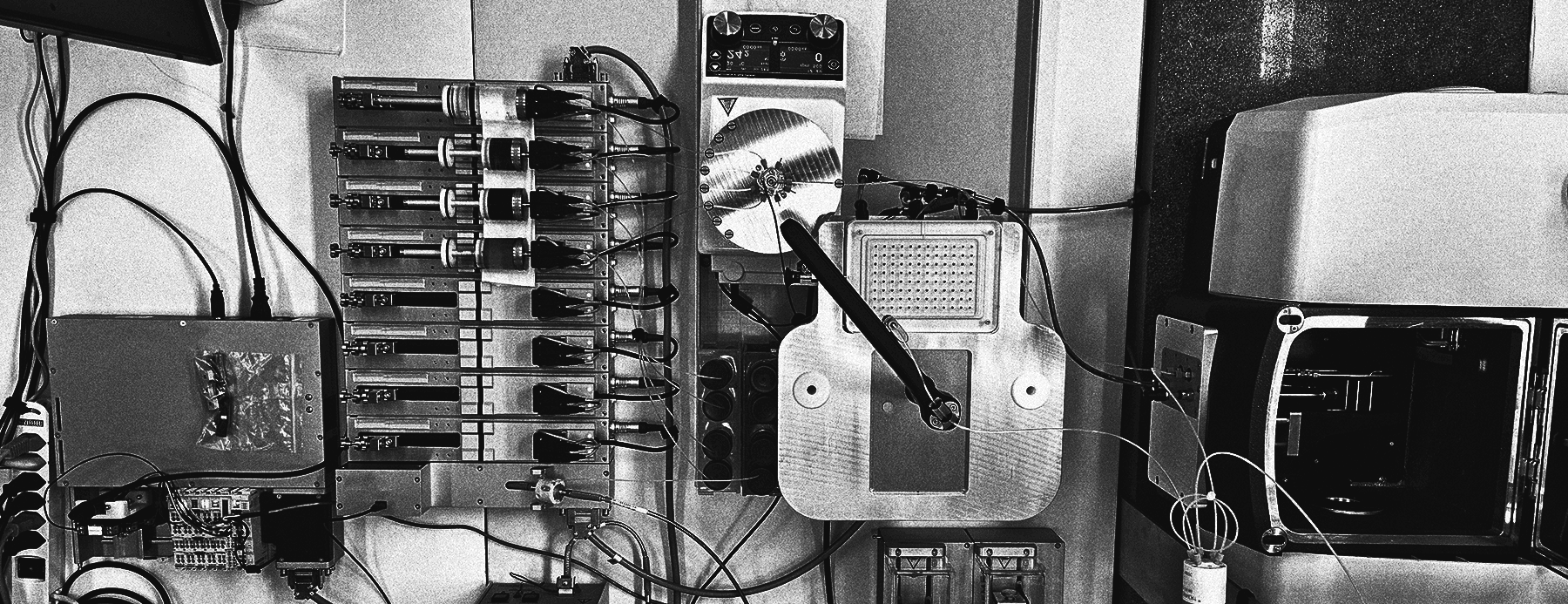
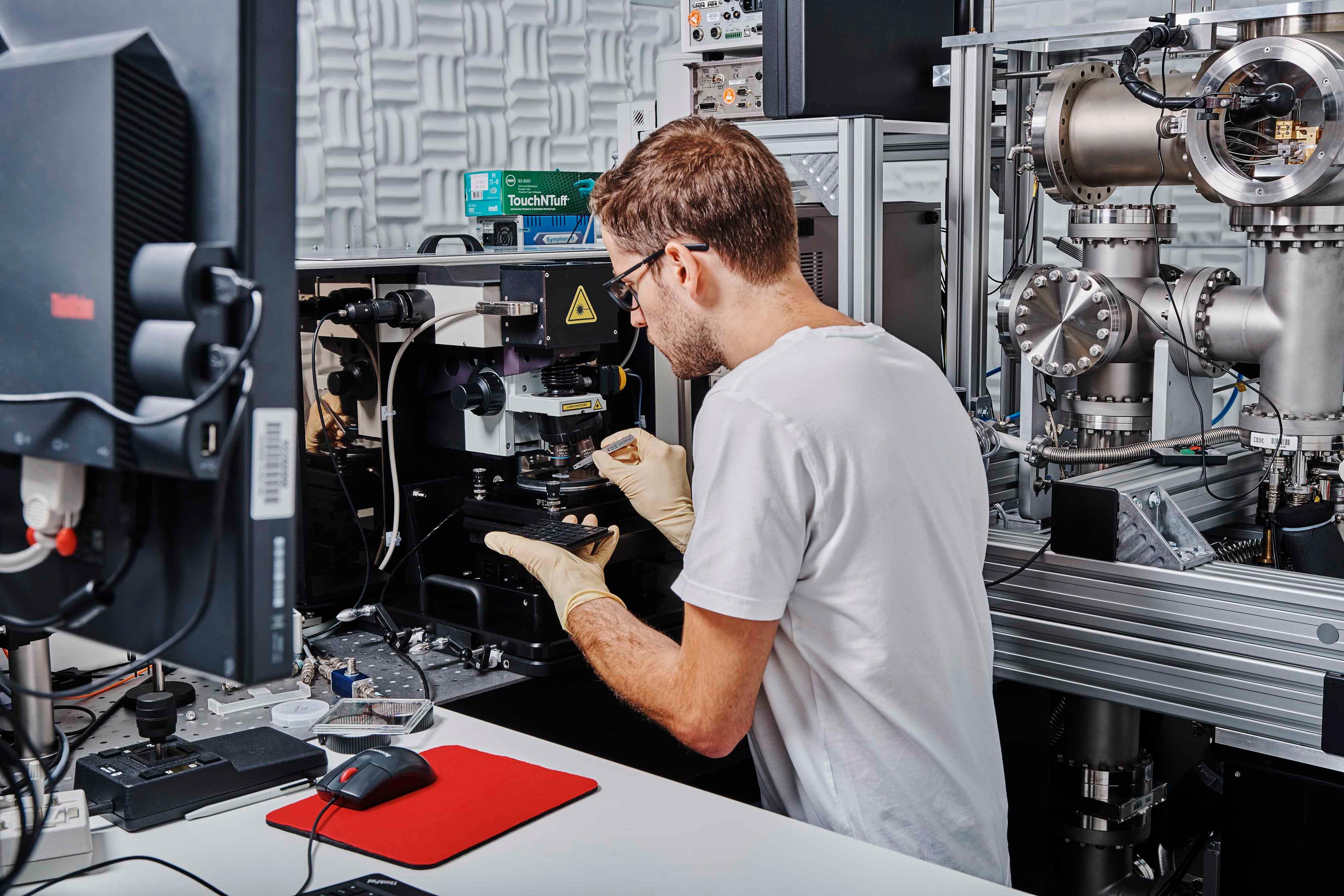
Capillarity-assisted assembly can provide high yields and precision with good reproducibility, but requires well-controlled process parameters. Special tools have been developed to provide this level of control. With our CAPA tools, it is possible to observe the assembly process microscopically. We can thus optimize parameters and investigate the dynamics of the assembly process.

EU projects

Collaborations within EU projects

NAPA: Emerging Nanopatterning Methods
Activity area FP6-NMP, project reference: 500120
Laurent Malaquin at CNRS/LPN, Paris, France
Lucia Curri at CNR IPCF Bari, Italy
Jurriaan Huskens, University of Twente, The Netherlands

 
 Adhesion-based transfer of particles  

Self-assembly and directed assembly are efficient and parallel processes, but they are usually incompatible with standard fabrication. Besides the colloidal chemistry involved, directed assembly requires "binding sites" on the surface to attract the particles and hold them in place. The effort to create such sites is costly and can impede functionality.

In the SATI process, assembly and integration are separated. This separation facilitates assembly methods in the first step, using templates with any needed pattern (Figure 7), from which the ordered particles are later transferred onto the final substrate (Figure 8). The prerequisite for the transfer that separates the steps is an adhesion cascade: adhesion has to increase in every step to bring all particles onto the next substrate.

The separation also facilitates the creation of functional substrate-particle connections. Depending on the application, it might be desirable to have a transparent or an electrically conductive junction or a very clean interface, for example for chip bumping or sparse colloidal lithography.

Finally, SATI can be applied multiple times to create stacks of particles (for example, from 100-µm glass beads as in Figure 9) or hierarchical assemblies of different particles (500-nm polystyrene beads on a 100-µm glass bead, Figure 10).

 
 Sparse colloidal lithography  

Colloidal lithographies use colloidal particles to define patterns for surface micromachining. Most frequently, these are polymer beads that pack in dense hexagonal layers. The gaps between the beads then define, for example, metal patterns.

When geometries other then simple hexagonal dense layers are required, one has to order the particle accordingly. Using the SATI process, however, spaced square arrays (or any pattern) can be fabricated, as shown in Figure 11.

Such particle arrangements can then be used in standard silicon technology, for example, to wet-etch metal layers or dry-etch into the underlying silicon.

 
 Chip bumping  

A standard task in semiconductor packaging is to electrically and mechanically connect the die to the package. This is commonly done by means of tin beads that are placed on the chip, brought into contact with the package, partially melted, and then cooled. With decreasing sizes, however, the handling of the beads becomes challenging and, ultimately, impossible: very small bumps are currently produced by means of electrochemical plating.

The SATI process can handle tin beads. Figure 12 shows 100-µm tin-coated beads assembled using a dry method called gravitational assembly. The beads were then taken out of the template in parallel and transferred onto an elastomer carrier to the final substrate. As the carrier was transparent, we were able to align the beads with the gold bonding pads of the substrate. A thin polymer layer provided sufficient adhesion so that the beads were transferred onto the gold pads. Finally, an annealing step removed the polymer and established an electrical connection.

 
    back to top
     
    About IBM Privacy Contact