
Rüschlikon, 3 March 2005 Given the rapidly increasing
data volumes that are downloaded onto mobile devices such as cell
phones and PDAs, there is a growing demand for suitable storage
media with more and more capacity. At CeBIT, IBM will for the first
time show the prototype of the MEMS*- assembly of a nanomechanical
storage system known internally as the "millipede"
project. Using revolutionary nanotechnology, scientists at the IBM
Zurich Research Laboratory, Switzerland, have made it to the millionths
of a millimeter range, achieving data storage densities of more
than one terabit (1000 gigabit) per square inch, equivalent to storing
the content of 25 DVDs on an area the size of a postage stamp.
Thousands of extremely fine tips "write" tiny pits representing
individual bits into a thin film of highly specific polymer. The
principle is comparable with the old punch cards, but now with structural
dimensions in the nanometer scale and the ability to erase data
and rewrite the medium.
The high storage density of more than a terabit was achieved by
using individual silicon tips to create pits approximately 10 nanometers
in diameter, i.e. 50,000 times smaller than the period at the end
of this sentence. Experimental chips have been designed comprising
more than 4,000 of these tips arrayed in a small 6.4 mm x 6.4 mm².
These dimensions make it possible to pack an entire high-capacity
storage system into the SD flash memory format package.
Technical product feasibility in terms of storage density, performance
and reliability was demonstrated in recent experiments using the
prototype on display. While current storage technologies are gradually
approaching fundamental limits, the nanomechanical approach has
enormous development potential: storage densities which correspond
to the size of molecular structures may even be possible. Moreover,
the nanomechanical data medium has been optimized to use a minimum
amount of energy. Thus, it is ideally suited for use in mobile devices
such as digital cameras, cell phones and USB sticks. Other possible
applications include lithography on the nanometer scale, as well
as atomic and molecular manipulation.
At CeBIT, a video microscope provides a look inside the storage
unit that reveals, for example, how the polymer surface is moved
across the tips with the help of a micromechanism (MEMS). An animated
illustration shows how the parallel tips of the read and write array
operate and how the individual tips work, and thus explains what
is happening on the nanometer scale.
Technological background
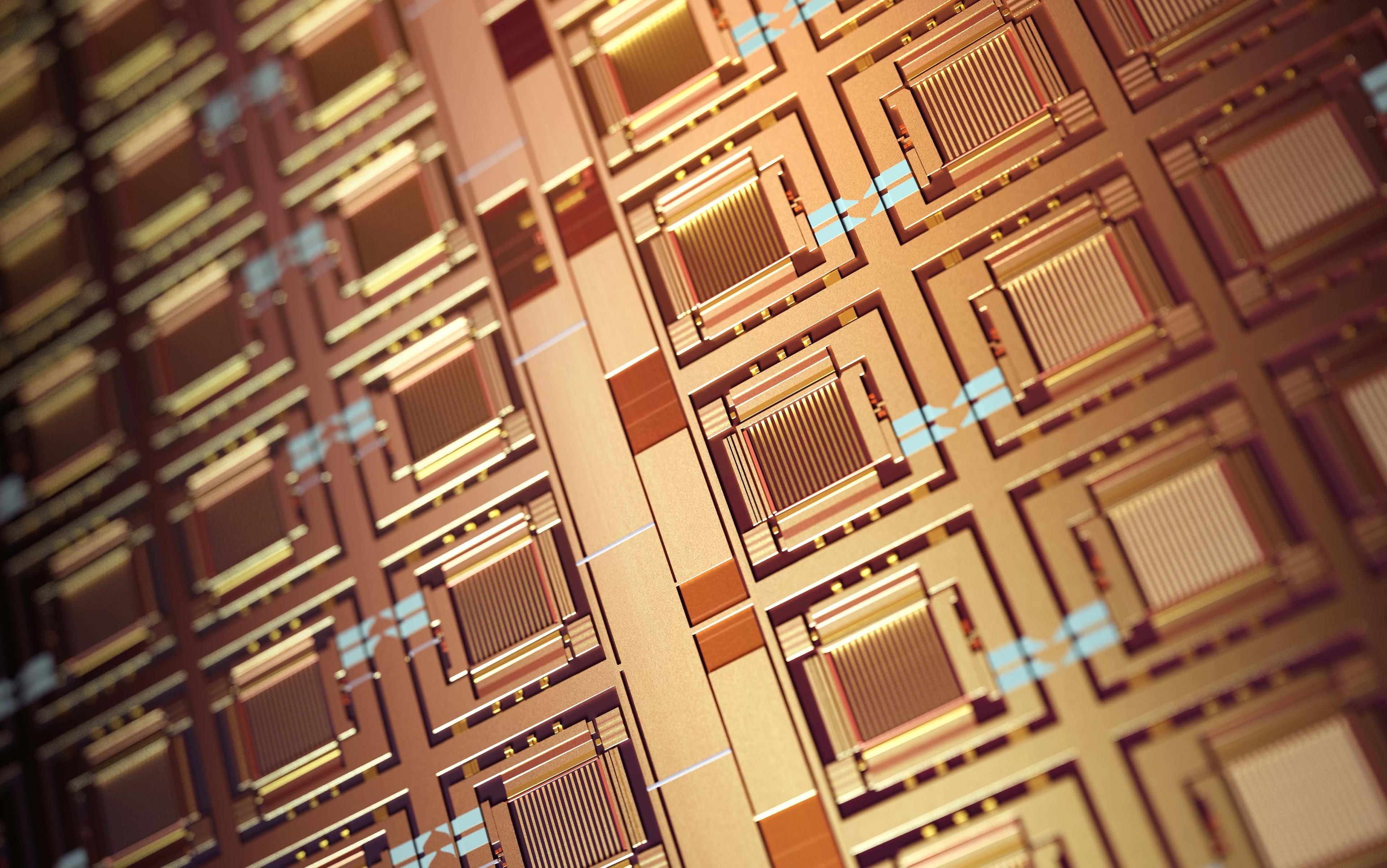
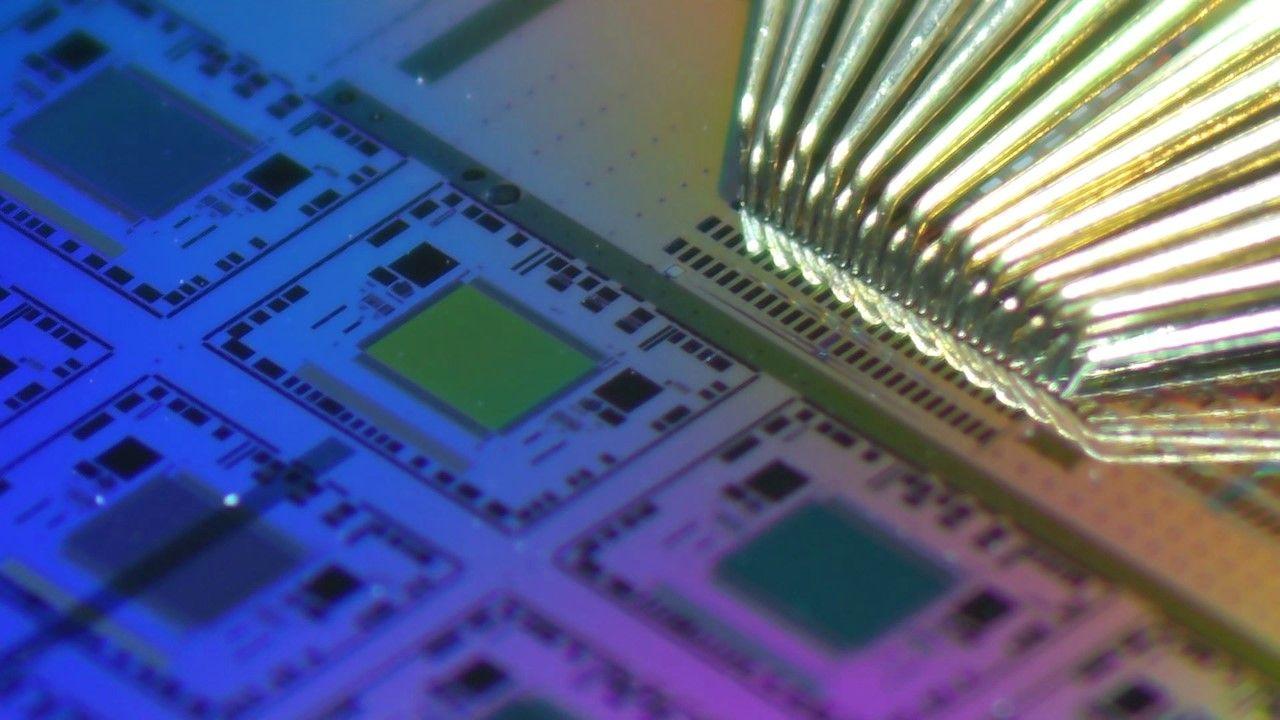
At the heart of the "millipede" technology is a two-dimensional
array of V-shaped silicon cantilevers, each 70 micrometers (thousandths
of a millimeter) long. At the end of each cantilever there is apart
from the tip a micrometer-sized sensor for reading as well as a
heating resistor above the tip, which is needed for writing. The
cone shaped tip is just under one micrometer in length and has a
radius of a few nanometers at its apex. The cantilever cells are
arranged in the form of an array on a 10 mm x 10 mm chip. One of
the recent array designs comprises a total of 4,096 (64 x 64) cantilevers.
The MEMS elements are etched out of a silicon single crystal using
existing technologies. The actual data medium is a thin polymer
film coated on a silicon substrate. The tips can independently read,
write or erase the bits.
A sophisticated design ensures that the tips are held level above
the storage medium with high precision and that external vibrations
and impacts are absorbed. To increase the data rate, read- and write-electronics
are used that allow the operation of multiple tips in parallel.
Electromagnetic actuation moves the storage medium very precisely
in the x and the y-direction so that each tip can read and write
within its storage field of 100 micrometers on a side. These short
distances are crucial for achieving fast access times.
For the device to perform its reading, writing, erasing or overwriting
functions, the tips are brought into contact with the polymer. Bits
are written by heating the tip to a temperature above the glass
transition temperature of the polymer by means of the heating resistor
integrated in the cantilever. The polymer in close proximity to
the tip is heated and becomes softer allowing the tip to indent
a few nanometers into the film mechanically stressing the material.
For reading, the cantilever's reading sensor, which is separate
from the tip, is heated slightly. As the polymer film is scanned
under the tip, the tip moves in and out of the written indentations.
When the tip moves into an indent, it cools down because of the
reduced distance to the substrate. This cooling results in a measurable
change in electrical conductivity of the sensor. To overwrite data
thermo-mechanical effects are used. They cause the stressed polymer
material closely around a newly created bit to relax. Thus, existing
pits can be erased by creating very close new ones. More than 10,000
writing and overwriting cycles have proved the concept's suitability
as a reusable storage medium.
* Micro-electro mechanical system.
|