
|
Zurich, Switzerland, May 26, 2006 Researchers at IBM's
Zurich Research Laboratory have succeeded in obtaining direct images
of the orbital reorganization that takes place when a gold atom
and a pentacene molecule form a complex on a surface. Apart from
its scientific beauty, the atomic-scale precision of this single-molecule
chemistry experiment breaks new ground in electrical contacting
capabilities with individual molecules, which could be of importance
for future electronics.
As reported in the May 26 issue of Science, IBM (NYSE: IBM)
scientists Jascha Repp and Gerhard Meyer have succeeded in the single-molecule
synthesis of a complex comprised of a metal and an organic molecule,
in this case gold and pentacene, respectively. They used a scanning
tunneling microscope (STM) to control the synthesis as well as to
characterize the reactants and products of the reaction. They found
that this synthesis is completely reversible and that the gold atom
can be bound to the molecule in different positions. Thus the synthesis
creates different structural isomers molecules with the same
chemical formula, but in which the atoms are arranged differently
with different properties. Moreover, because the synthesis
is performed on an insulating surface, namely sodium chloride (NaCl),
the molecular orbitals of the pentacene as well as of the resulting
isomers can be imaged directly using an STM.
Apart from its scientific beauty, the atomic-scale precision of
this single-molecule chemistry experiment reaches new heights in
electrical contacting capabilities with individual molecules. It
demonstrated that it is not only possible to control the atomic-scale
geometry of a metal-molecule contact, but also its coupling strength
and the phase of the orbital wavefunction at the contact point.
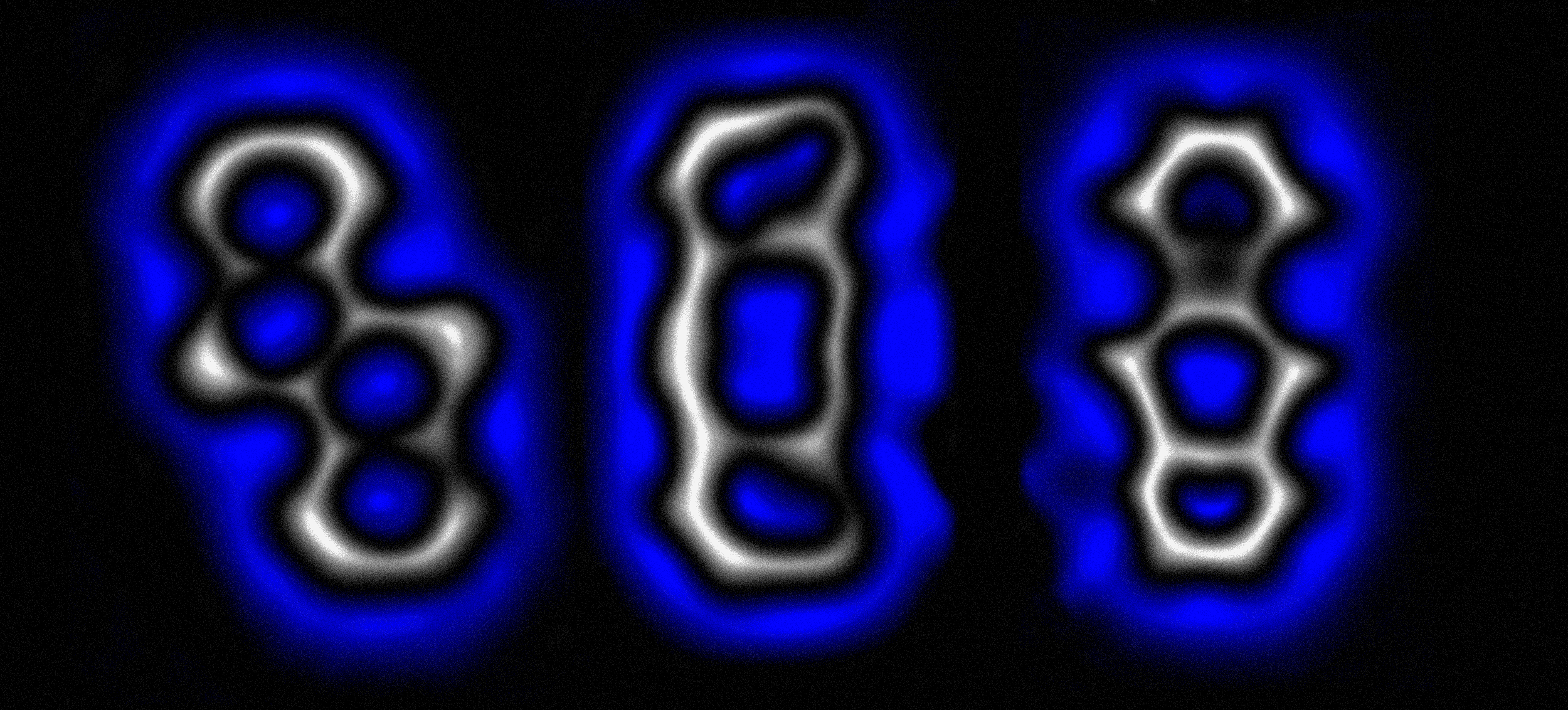
"We can take an image of the molecular orbitals before and
after bond formation," explains Jascha Repp, who carried out
the experiment, "and thus directly see the changes in shape,
energetic position, and occupation of the orbitals upon bond formation.
One can take the complex apart again, attach the gold atom in a
different position, and have a look at the new orbitals."
Gerhard Meyer, who leads the STM-related efforts at IBM's Zurich
Research Laboratory, says, "In this way, one can of
course, within the general limitations of chemistry engineer
the orbital structure of molecules, and create different kinds of
contacts between, in our case, a gold atom and a pentacene molecule."
With the unbroken trend to ever smaller building blocks in future
electronics, the amount of control in terms of precise geometry
and even of the phase of the electronic wavefunctions, will become
a crucial issue. "Eventually chip dimensions might become so
small that interference effects will become important," explains
Rolf Allenspach, who manages Zurich's research efforts related to
the physics of nanoscale systems, "so one needs to understand
and exploit such effects."
To investigate the geometrical arrangement and the details of the
chemical bond formed, the experimental orbital images have been
compared with those calculated using density-functional theory.
With the help of these calculations, which were carried out by Sami
Paavilainen of the Tampere University of Technology (Finland), Fredrik
E. Olsson of the Chalmers University in Göteborg (Sweden) and
Mats Persson of the University of Liverpool (UK), the different
isomers formed in the experiment could be unambiguously assigned
to their corresponding geometrical structures and the nature of
the chemical bond could be identified.
The collaboration was conducted within the framework of the European
Union (EU) projects "CHIC", "AMMIST", "NANOSPECTRA",
and "NANOMAN".
The scientific paper entitled "Imaging Bond Formation Between
a Gold Atom and Pentacene on an Insulating Surface" by J. Repp,
G. Meyer, S. Paavilainen, F. E. Olsson, and M. Persson was published
in Science, Volume 312, Number 5777, pp. 1196-1199 (26 May
2006).
About the IBM Zurich Research Lab
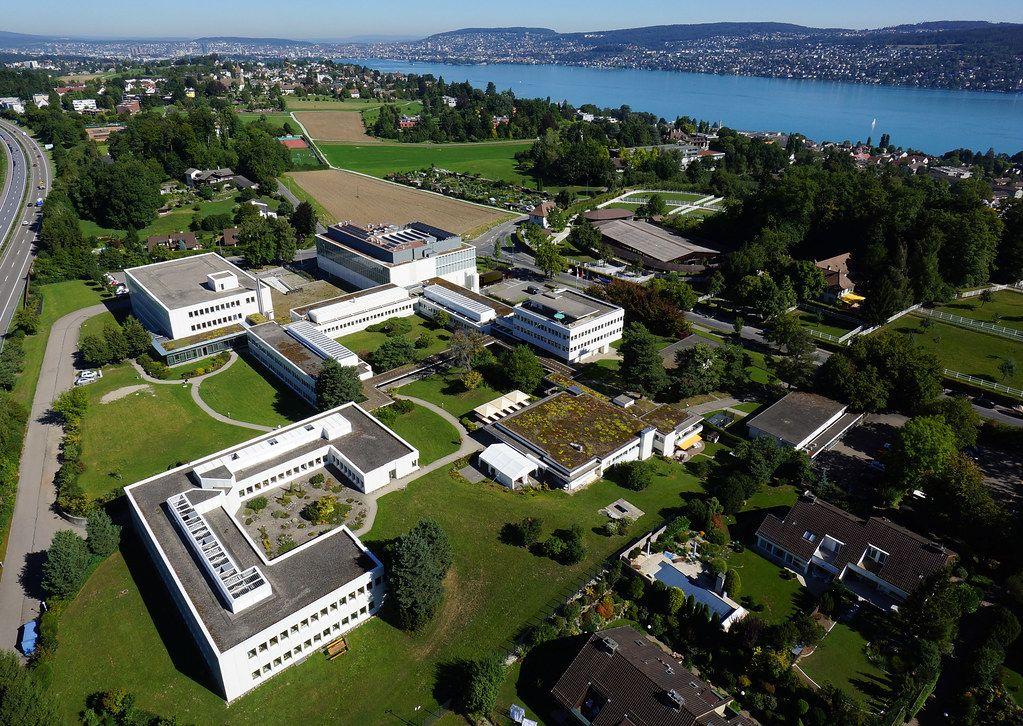
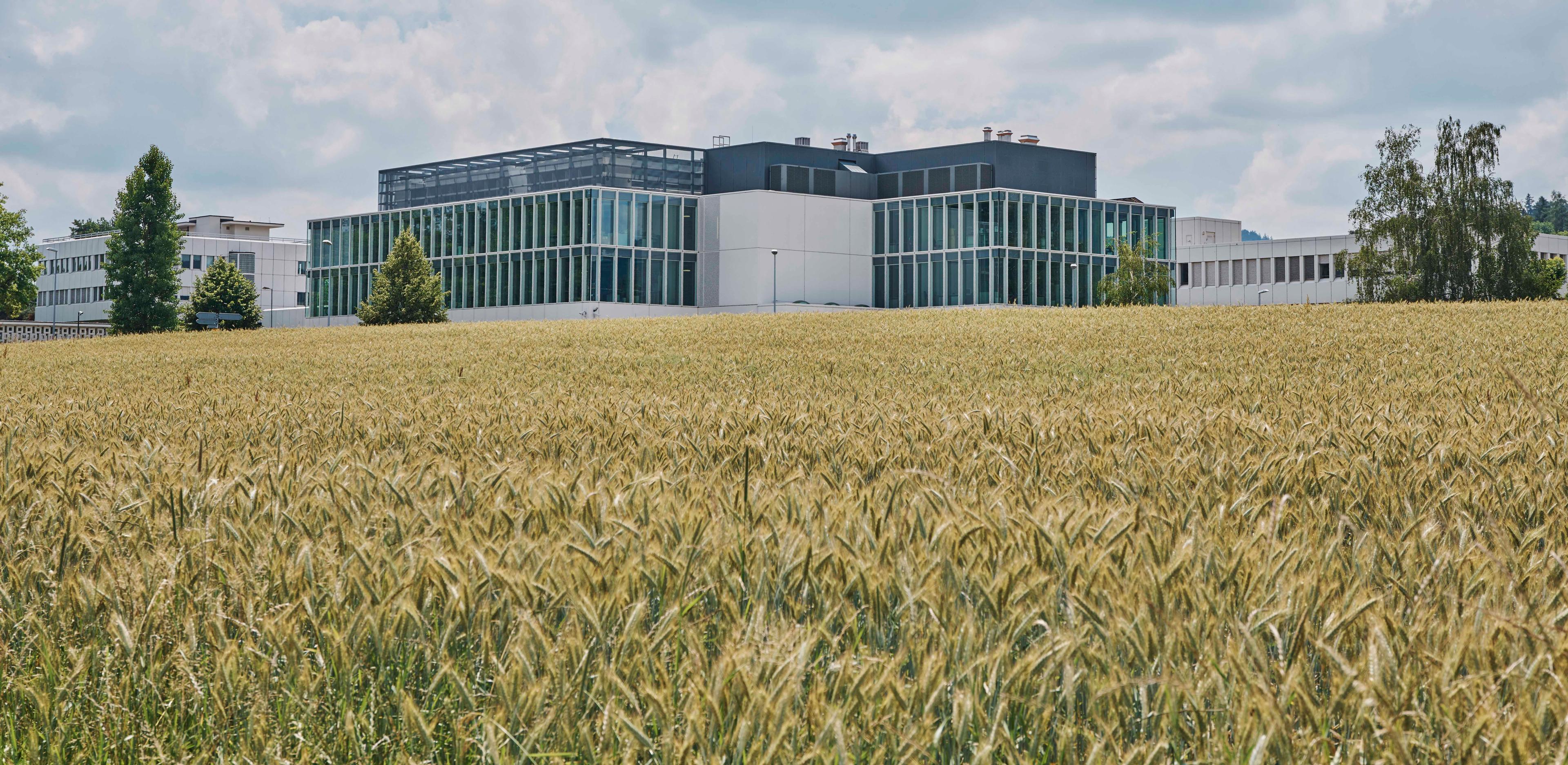
The IBM Zurich Research Laboratory (ZRL) is the European branch
of IBM Research and celebrates its 50th anniversary in 2006. This
network of some 3200 employees in eight laboratories around the
globe is the largest industrial research organization in the world.
The Zurich laboratory itself currently employs about 320 people,
representing more than 30 nationalities. World-class research and
outstanding scientific achievements, most remarkably two Nobel Prizes,
are associated with this lab. The spectrum of research activities
at ZRL ranges from exploratory research to the development of computer
systems and software to the designing of novel business models and
services that are becoming available "On Demand".
|