

IBM Scientists Reinvent Medical Diagnostic Testing

Silicon Chip Tests for Disease in Rapid Time, Using Microscopic Sample

Top story

English | Deutsch

zrl_pointofcare_1Zurich, Switzerland, November 17, 2009—IBM (NYSE: IBM) scientists have created a one-step point-of-care-diagnostic test, based on an innovative silicon chip, that requires less sample volume, is significantly faster, portable, easy to use, and can test for many diseases, including one of world's leading causes of death, cardiovascular disease*. The results are so quick and accurate that a small sample of a patient’s serum or blood, could be tested immediately following a heart attack, to enable the doctor to quickly take a course of action to help the patient survive.

As reported in Lab on a Chip, December 2009, Volume 9, Issue 23, IBM Research - Zurich scientists Luc Gervais and Emmanuel Delamarche, in collaboration with the University Hospital of Basel in Switzerland, have developed a new diagnostic test that uses capillary forces to analyze tiny samples of serum, or blood, for the presence of disease markers, which are typically proteins that can be detected in people’s blood for diagnostic purposes. Capillary action force is the tendency of a liquid to rise in narrow tubes or to be drawn into small openings. An everyday example of a capillary action force can be viewed by dipping a paper towel in a cup of water — the microstructures in the paper fiber enable the towel to absorb the water.

"This point of care test has achieved the trifecta for medical staff in that it is portable, fast and requires a very small volume of sample," comments Emmanuel Delamarche, scientist, IBM Research - Zurich. "We are giving back precious minutes to doctors so they can make informed and accurate decisions right at the time they need them most to save lives".

All in the chip

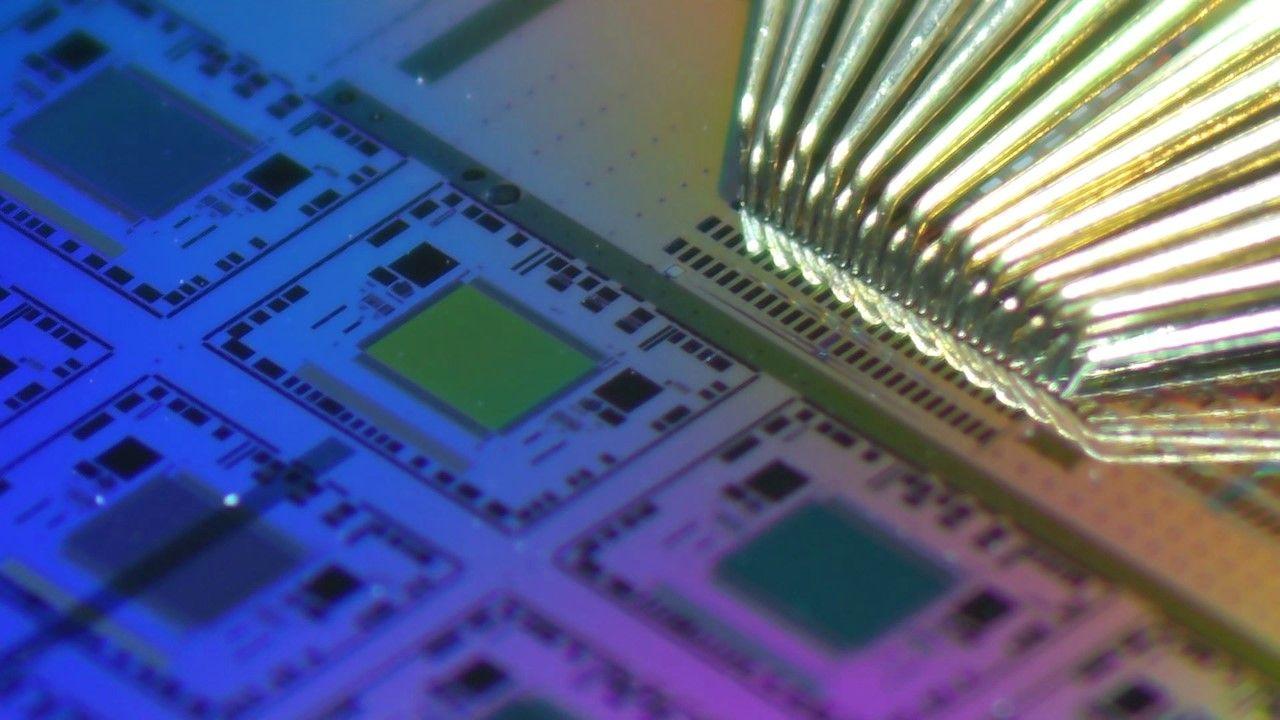
IBM scientists have encoded the forces of capillary action on a microfluidic chip made of a silicon compound, similar to those used in computer chips, thus leveraging IBM's vast experience in developing and manufacturing silicon semiconductor wafers. The chip, which measures 1 × 5 centimeters, contains sets of micrometer wide channels where the test sample flows through in approximately 15 seconds, several times faster then traditional tests. Uniquely, the filling speed can be adjusted to several minutes when the chip requires additional time to read a more complex disease marker.

The microfludic chip, which is based on nearly three years of research and development, consists of a microscopic path for liquids with five innovative stages:

Collaboration

True to IBM's strategy of open collaboration, scientists in Zurich tested their ideas with academic and healthcare partners. This research also would not have been possible without the generous support of KTI/CTI, an organization which fosters innovation in Switzerland.

"This microfluidic chip is the next step in the evolution of point of care devices. We look forward to working with the scientists at IBM Research - Zurich to develop this innovation even further," said Thierry Leclipteux, Chief Executive Officer and Chief Science Officer, Coris BioConcept.

IBM scientists designed the chip with flexibility in mind in both its form and uses. Due to its small size the chip can be embedded in several types of form factors, depending on the application, including a credit card, a pen or something similar to a pregnancy test. Besides diagnosing diseases, the test is also flexible enough to test for chemical and bio hazards.

Why IBM?

From a technological perspective, IBM has been a pioneer in nanoscience ever since the development of the Nobel Prizing winning Scanning Tunneling Microscope in 1981. Ever since, IBM researchers have been pushing the frontiers of scientific knowledge and manipulating at the nano scale and our work in one-step point-of-care diagnostics is a direct result of this effort. IBM is currently embarking on a grand vision called smarter planet helping industries, such as healthcare become more instrumented, interconnected and intelligent.

IBM's track record of improving healthcare through scientific achievements and collaboration with healthcare companies dates back to the 1950s. In the past decade, IBM has developed a national digital mammography archive with the University of Pennsylvania; developed a clinical trial participant system with the Mayo Clinic; collaborated with Scripps to understand how influenza viruses mutate and proactively develop treatments; collaborated with European universities to develop better methods to decide on antiretroviral therapies for HIV; launched the World Community Grid, which has done projects on cancer, aids, dengue fever; and much more.

*According to the World Health Organization Statistics 2009.

The scientific paper entitled “Toward one-step point-of-care immunodiagnostics using capillary-driven microfluidics and PDMS substrates” by Luc Gervais and Emmanuel Delamarche, appears in Lab on a Chip, Volume 9, Issue 23, pp. 3330 to 3337 (December 2009).

About Coris
A biotechnology company developing rapid tests for diagnosis of enteric and respiratory pathogens. For more information visit www.corisbio.com/.

Note to Editors: Broadcast quality and streaming video is available to registered journalists and bloggers at: http://thenewsmarket.com/ibm.

back to top

Contact us

Nicole Herfurth
Media Relations
IBM Research GmbH
IBM Research - Zurich
Säumerstrasse 4
8803 Rüschlikon
Switzerland

Tel +41 44 724 8445
Fax +41 44 724 8952
e-mail: nih@zurich.ibm.com

Press kits

Share/Bookmark