
|
1000 Tips for Ultrahigh-Density Data Storage
Zurich/Switzerland, October 11, 1999 -- Will micro- and nanomechanic
systems be able to compete with electronic and magnetic devices?
A novel concept developed at IBM's Zurich Research Laboratory promises
high-density storage using mechanical components derived from atomic
force microscopy (AFM): tiny indentations poked into a polymer layer
by AFM tips represent stored bits that can be read out by the same
tip. High data rates can be achieved by parallel operation of a
large number of tiny tips in a small area. IBM scientists believe
that it is possible to reach storage densities of up to 80 billion
bits per square centimeter (80 Gbit/cm²), which is up
to five times more than the expected ultimate limit for magnetic
storage. A research prototype of the "Millipede", as the
scientists nicknamed their novel device, demonstrates the feasibility
of this new approach to ultrahigh-density storage.
"Mechanical" scanning probe techniques, specifically
the scanning tunneling and the atomic force microscope invented
at IBM's Zurich Research Laboratory, have demonstrated the potential
of mechanics in very small dimensions not only for imaging purposes,
but also for modifications on the nanometer scale and even for precise
positioning of individual atoms and molecules. The movement of tiny
mechanical components consumes little energy and can be quite fast,
and wear is less of a problem than with larger mechanical systems.
Nanomechanical devices, however, became feasible only because they
lend themselves to batch fabrication similar to microelectronic
chip manufacturing, thus opening up the VLSI (very large scale integration)
age of micro- and nanomechanics.
A group at IBM's Almaden Research Center in San Jose, California,
pioneered micromechanical data storage based on AFM technology:
a fine tip on the free end of a minute bar called a cantilever was
operated over a spinning disk, an arrangement similar to that of
a magnetic storage disk drive. The read-only system used disks replicated
from a master, and had 100-nm-sized features sensed by an AFM tip
as zeros and ones at densities of up to 10 Gbit/cm²,
a hundred times the data density of a CD-ROM. In an experimental
write-once/ read-only scheme, an AFM tip heated by electrical pulses
poked indentations representing the data bits into a thin polymer
layer at densities of more than 5 Gbit/cm². Mechanical
response times allowed readback data rates of up to 10 Megabit per
second. To push the data rate of AFM-based storage into the range
of today's magnetic recording and beyond, the researchers at IBM's
Zurich Research Laboratory used parallel operation of a large number
of tips arranged in a two-dimensional array over a non-rotating
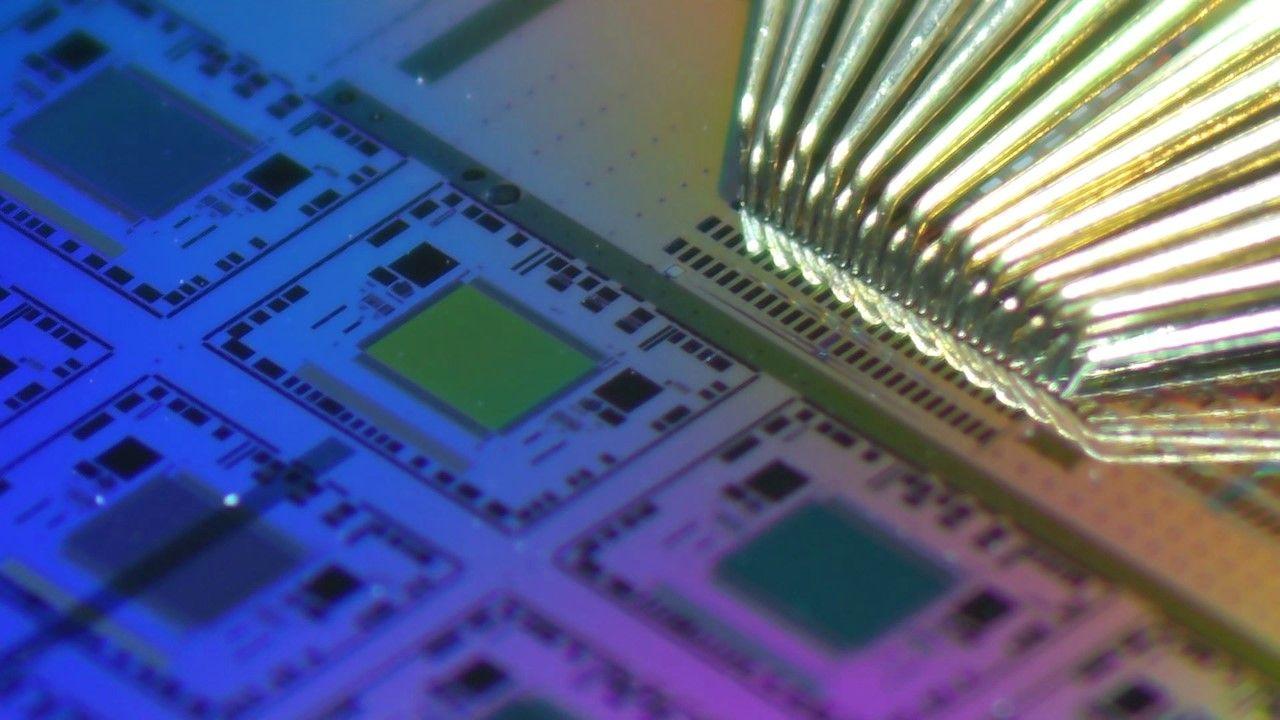
storage medium. A first experimental device consisted of 25 tips
arranged in a 5 x 5 grid on a 25 mm² silicon area. The
next generation device, which is operating in the laboratory today,
has 1024 tips in a 32 x 32 array in an area of 3 mm x 3 mm. Indentation
sizes and spacing as small as 30-40 nanometers (nm) have been demonstrated
with single tips, which leads to a storage density of 60 - 80 Gbit/cm².
Parallel operation of the more than 1000 tips is expected to make
possible data rates of more than hundred Megabit/second. The team
at IBM's Zurich Research Laboratory also demonstrated that the storage
medium can be erased by heating up the polymer and restoring it
to its original state by a reflow process. This process does not
allow bit-level erasing, which is, however, not required in most
applications.
"We have demonstrated for the first time that it is possible
to realize arrays of more than one thousand tips on a chip, and
that devices like the Millipede may take thermomechanical data storage
considerably beyond the density of magnetic storage technology,"
says Peter Vettiger who leads the Millipede research effort at IBM's
Zurich Research Laboratory. "However, our work is still in
the early stages of development, and the use of a polymer as the
storage media is only one of several possible solutions. If the
required functionality can be integrated into cantilevers and tips,
the Millipede concept may become a universal read/write device for
future storage systems and even for other applications, such as
large-area imaging and nanoscale lithography, as well as atomic
and molecular manipulation." The availability of very small
storage devices only a few centimeters or even millimeters across
will open up new possibilities for integrating computer power into
small pervasive devices such as video cameras, mobile phones or
even watches.
|