
|
Moore's law describes how electronic components shrink and the
numbers of transistors increase by a factor of 2 every 18 months.
This causes an explosion of power density
that becomes a huge problem for the industry and requires a concerted
effort to develop methods to create chips with better energy efficiency
and, at the same time, to improve thermal management.
Chips are mounted in computers with their active side facing downwards
(flipped chip) onto a carrier that supplies power and signal lines.
The upper side is covered with a copper cap and a cooler (figure
top center and right). The gaps between the chip, the cap, and the
cooler are filled with a thermal interface material
(TIM, red lines top right) that allows the differential expansion
of the chip and the cooler. These TIMs dominate the thermal resistance,
causing approximately 50% of the overall thermal gradient: Thermal
interfaces are key components when heat has to flow from a source
to a sink that are made of different materials. Simply pressing
surfaces on top of each other would create excessively large resistance
to the heat flux.
Hierarchical nested channel (HNC) interfaces reduce the flow resistance
of TIMs into and out of narrow (< 25 µm) gaps
or bond lines by two orders of magnitude for Newtonian fluids. This
allows the use of smaller bond lines with viscous thermal pastes.
The effect is achieved using micrometer-sized channels that delineate
primary posts and provide paths for evacuation of the paste during
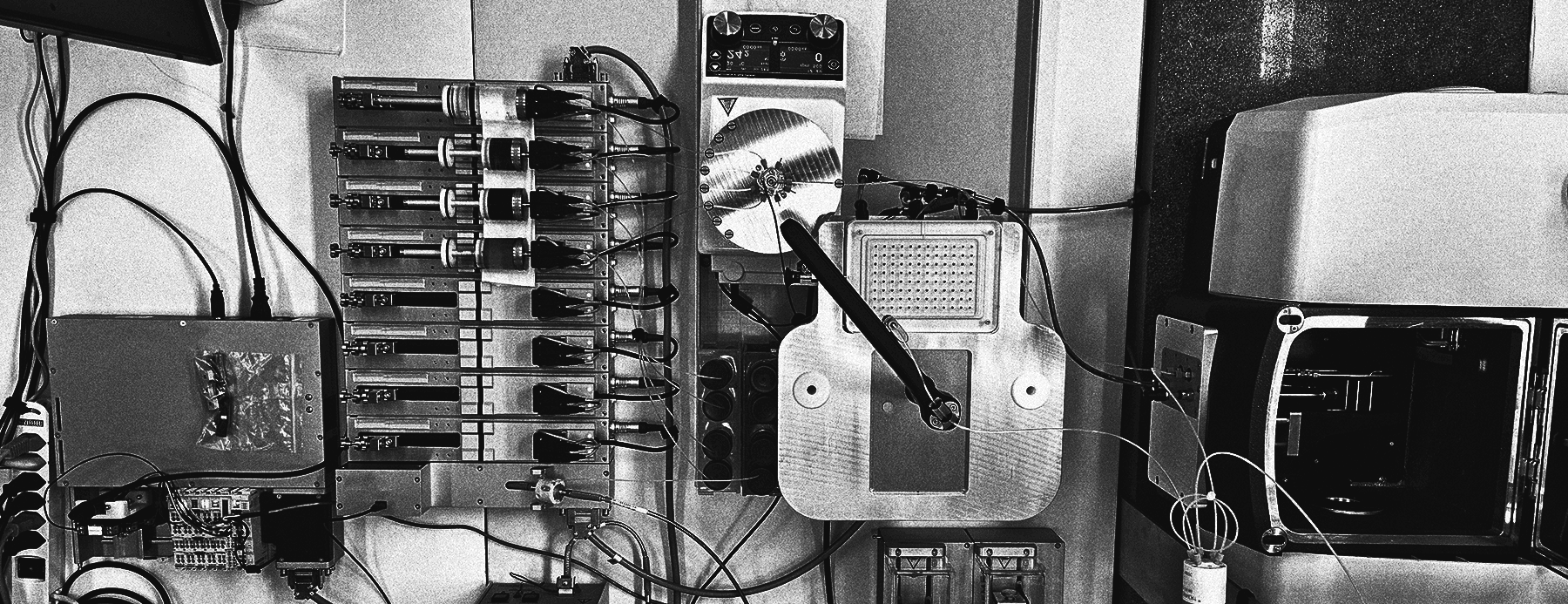
assembly (center). The improved squeezing speed and the thermal
resistance are measured in a setup where a controlled load is applied
between a heater and a cold plate (left).
HNCs provide the desired effect because local squeezing is addressed
by short and narrow channels, whereas wider channels are responsible
for long-range evacuation of the paste. In fact HNC interfaces offer
a compromise regarding the conflicting requirements of densely packed
posts, large flow channels, and large thermal contact area. For
example, an HNC with 3 levels of hierarchy and 6 elements per hierarchy
is shown (bottom right). With a channel width being 0.08×
the pattern pitch, an overall post area > 90% results. HNCs
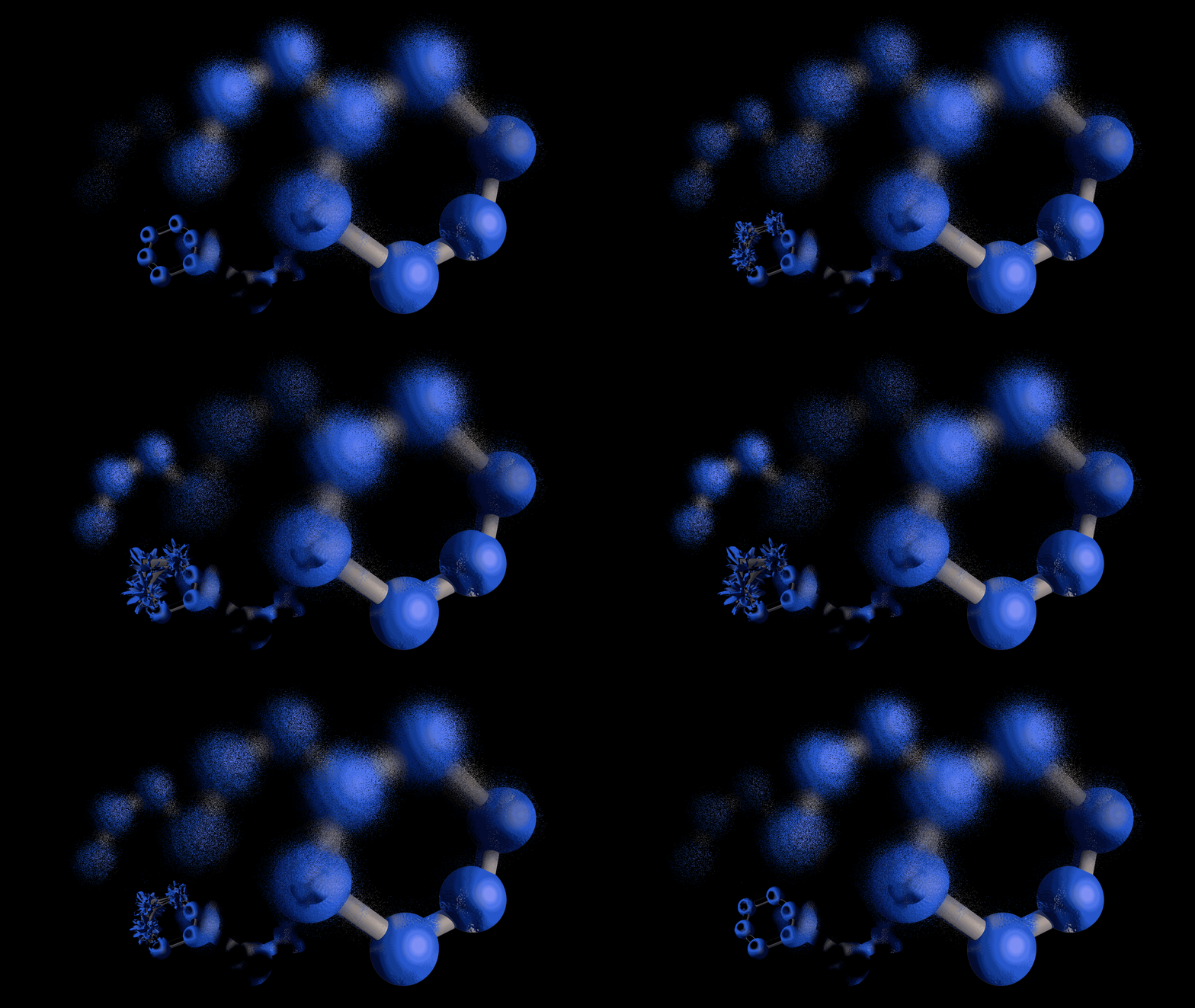
also alleviate the voiding or paste pumping problem caused by the
cyclic paste flow during heating and cooling cycles of the chip.
Paste pumping causes an air bubble with branched fractal dimensions
to replace the paste an effect that is explained by the Hele
Shaw theory. HNCs provide paths for paste flow, thus eliminating
the growth of air bubbles (bottom, second from left).
In summary we use HNCs to reduce the thermal resistance of paste
interfaces 5-10× to improve cooling efficiency and to improve
resistance against paste voiding. With this effort we extend the
lifetime of air cooling and create a better thermal contact for
liquid coolers.
References
| [1] |
P.A.E. Schoen, B. Michel, A. Curioni, and D. Poulikakos, "Hydrogen-Bond Enhanced Thermal Energy Transport at Amphiphilic Silica-Water Interfaces," Phys. Rev. Lett. in press (2008).
|
| [2] |
T. Brunschwiler, U. Kloter, R.J. Linderman, H. Rothuizen, and B. Michel, "HNC for Fast Squeezing Interfaces with Reduced Thermal Resistance," IEEE Trans. Comp. Packag. Technol. 30, 226 (2007).
|
| [3] |
R. J. Linderman, T. Brunschwiler, U. Kloter, H. Toy, and B. Michel, "HNC for Reduced Particle Stacking and Low-Resistance Thermal Interfaces," 23rd IEEE SEMI-THERM, March, 18-22, San Jose, CA, USA, (2007). Including Best Paper Award.
|
| [4] |
R. Linderman, T. Brunschwiler, B. Smith, and B. Michel, "High-Performance Thermal Interface Technology Overview," 13th THERMINIC, Sept. 17-19, Budapest, Hungary, (2007).
|
| [5] |
B. Smith, T. Brunschwiler, and B. Michel, "Untility of Transient Testing to Characterize Thermal Interface Materials," 13th THERMINIC, Sept. 17-19, Budapest, Hungary, (2007).
|
 |
|
 |
 |
Section through chip with
thermal interfaces and cooling cap. |
 |
 |
|
 |
 |
 |
Squeeze flow between chip
and cooler with an additional channel (right). Arrows show the
large flow differences due to the larger dimensions of the channel
plus squeeze gap (d+h). |
 |
 |
|
 |
 |
 |
Setup for mechanical and
thermal measurements of thermal interface materials. Performance
of HNC and flat caps are compared on this setup. |
 |
 |
|
 |
 |
 |
SEM of three-level hierarchical
nested channel interfaces with an array size of six posts etched
into silicon by a deep-trench RIE process. |
 |
 |
|
 |
 |
 |
Comparison of paste pumping
on flat interface (left) and HNC interface (right) showing the
resistance of the HNC against paste pumping and the thinner
interface that can be reached. |
 |
 |
|
 |
 |
|